AI Acquisition Assistant for Real Estate Investors: From Qualification to Appointment Booking
Real estate investors do not usually lose deals because they lack ambition. They lose deals because speed breaks down, follow-up gets inconsistent, and good leads cool off while the team is buried in callbacks, texts, and half-finished notes. That is where an AI acquisition assistant starts to matter, not as a novelty, but as a practical layer between incoming seller interest and an actual booked appointment.
For investors, especially wholesalers, buy-and-hold operators, and acquisitions teams managing multiple marketing channels, the hardest part is rarely generating a name and phone number. The hard part is what happens next. A prospect replies to a text at 9:17 p.m. A seller calls while your team is on another line. Someone submits a form from PPC and expects a response in minutes, not tomorrow morning. Another lead says, “Maybe after probate clears up,” and disappears for six weeks unless a follow-up system keeps the conversation alive.
That gap between lead capture and human conversation is where real estate AI has become useful. Used well, it can support lead qualification, seller follow up, and appointment booking without replacing judgment. Used poorly, it becomes noise, creates compliance risk, and damages trust with motivated seller leads.
The difference is not the label on the software. It is how the system is designed.
What an AI acquisition assistant actually does
A lot of people hear “AI for real estate investors” and picture some magical black box that closes deals. That is not the job. In an acquisitions workflow, the more realistic role is narrower and more valuable. The assistant handles repetitive communication tasks, keeps response times short, and gathers enough context so a human acquisitions rep enters the conversation with momentum.
At a practical level, that means an AI real estate assistant may respond to inbound inquiries, continue SMS follow up, answer or return missed calls, ask qualifying questions, and route warmer prospects toward an appointment. In the strongest setups, it works across channels rather than treating phone, SMS, and CRM activity as separate worlds.
That cross-channel piece matters more than people realize. A seller who ignores email may answer a text. A lead who misses a call may respond to a missed-call text back. A prospect who is not ready today may engage again after several touches spread over days or weeks. Real estate follow up automation is effective precisely because sellers do not all move on the same schedule.
This is also why many investors are shifting from disconnected tools toward a single real estate investor CRM or investor CRM that combines communications and lead management. When texts live in one app, calls in another, and notes in a spreadsheet, seller lead follow up becomes fragile. Every handoff introduces delay. Every delay lowers contact rates.
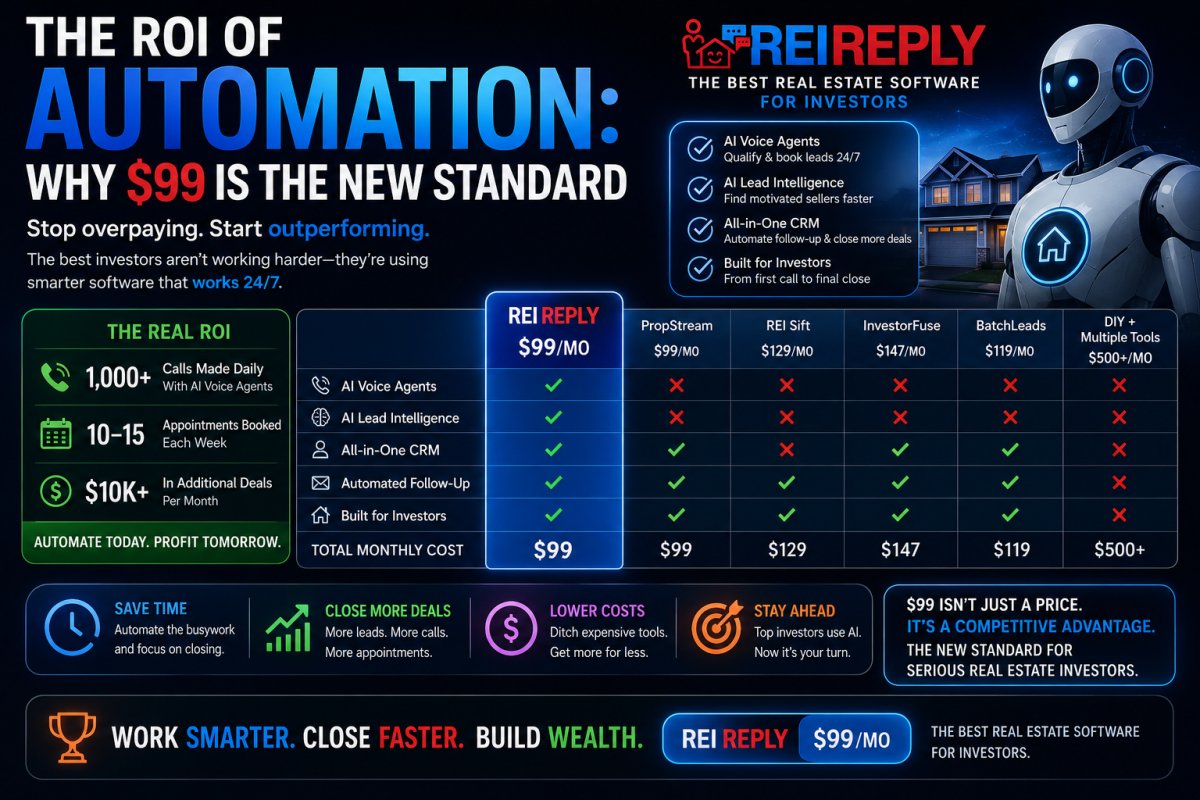
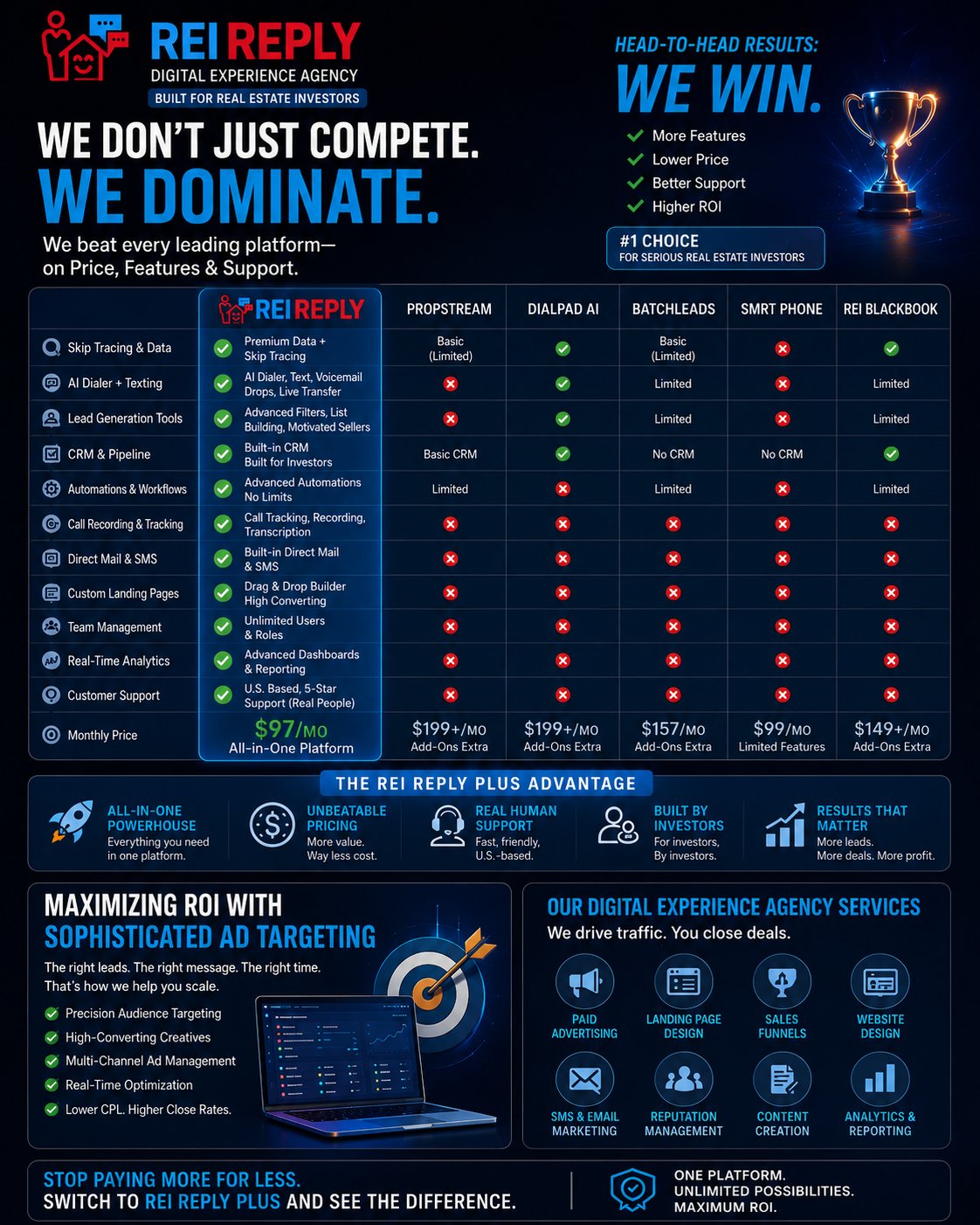
REI Reply is one example of a platform positioned around that problem. It describes itself as a CRM and follow-up system built specifically for real estate investors, combining inbound and outbound calling, SMS, missed-call text back, and AI voice assistants in one place. It is presented not as a lead provider in the traditional sense, but as a conversion engine for leads the investor is already generating through channels like PPC, SEO, cold calling, or SMS marketing for real estate investors. Its site also says subscribers get access to verified motivated seller data through REI AI Leads, which puts data, outreach, and follow-up into the same operating environment.
That framing is important. The best real estate investor software does not pretend to eliminate the need for marketing or acquisitions skill. It tries to make every lead source perform better.
Why qualification is the pressure point
Anyone who has worked acquisitions knows that “lead” is a broad word. A seller lead can mean a genuinely distressed owner ready to move quickly, or it can mean a curious person who wants retail pricing and has no timeline. Both deserve a respectful conversation, but they do not deserve the same amount of immediate human labor.
That is why AI lead qualification has become such a practical use case. The goal is not to reduce a person to a score. The goal is to separate urgency from casual interest, and to do it fast enough that your closers spend their time where it counts.
In real estate acquisitions, even basic qualification helps. Is the owner open to selling? Is there a timeline? Is the property occupied? Is the seller dealing with a situation that creates motivation, such as inherited property, vacancy, financial strain, or a need for speed and convenience? You do not need every detail at once. You need enough to decide whether the next step is an appointment, a nurture sequence, or a simple pause.
A good AI follow up system can ask those questions in a way that feels like a conversation rather than an interrogation. Tone matters here. Seller motivation is often tied to stress, embarrassment, grief, or frustration. If your automated lead follow up sounds robotic or overly aggressive, you may get responses, but not trust. And trust is what moves a lead from curiosity to a serious appointment.
I have seen teams make the mistake of stuffing every possible question into the first interaction. They want condition, timeline, payoff amount, asking price, occupancy, repairs, reason for selling, and whether there are code violations, all before a human has spoken to the person. That may look efficient on a whiteboard, but in live conversations it often kills momentum. Real estate lead nurturing works better when the system collects just enough to move the process forward, then hands the conversation to the right person at the right time.
The role of SMS in investor follow-up
SMS remains central to seller lead automation because it is immediate, lightweight, and easier for many property owners than answering a cold call. That is why terms like automated SMS, real estate SMS marketing, real estate investor texting, and SMS follow up show up so often in conversations about real estate automation.
Still, there is a gap between sending texts and building a reliable real estate SMS automation system. The first is easy. The second takes discipline.
Text message marketing real estate campaigns work best when they are tied to the actual stage of the lead. A fresh inbound lead should not receive the same messaging as an old cold prospect from a skip traced list. A person who just missed your call should get a different text than someone who has not engaged in 45 days. A seller who explicitly says, “Call me tomorrow after 5,” should be handled differently from someone who says, “Not interested.”
This sounds obvious, but many real estate marketing automation setups still blast uniform sequences without context. That is one reason deliverability and response quality suffer. Carriers and recipients both react badly to generic traffic.
REI Reply highlights several messaging and workflow features on its site, including automated follow-up, Spintax, and text-deliverability-oriented tools described as Humanizer features. The operational idea is sensible. In real estate SMS marketing, message quality and variation can affect whether a text feels like a legitimate conversation or obvious bulk automation. But even the best SMS automation software cannot rescue bad segmentation or poor judgment. If your campaign targets the wrong people, sends https://damienoytd060.fotosdefrases.com/building-a-real-estate-investor-lead-generation-system-with-automation-software at the wrong time, or ignores prior responses, the automation simply makes the mistake happen faster.
For investors using SMS for real estate investors, the real gain is consistency. Leads do not slip through the cracks. Follow-ups do not depend entirely on whether one acquisitions rep remembered to circle back after lunch. A prospect who is not ready today can stay in a real estate lead nurturing path until the timing changes.
Voice AI and the missed-call problem
Phone response is still critical in motivated seller lead generation. Some sellers want to talk immediately, especially when the issue is urgent. Others may never fill out a form but will call a number from a direct mail piece, PPC ad, or local search result. If that call goes unanswered, the odds of recovering the opportunity drop fast.
This is where voice AI for real estate investors becomes interesting. An AI phone agent real estate setup can answer, engage, qualify, and potentially book the next step instead of sending the caller to voicemail and hoping for a callback later. REI Reply states that its AI voice agent can qualify leads, book appointments, and follow up 24/7 across calls, SMS, email, and social channels.
That 24/7 coverage is not just about convenience. It addresses one of the ugliest operational truths in acquisitions: leads do not arrive neatly during office hours, and many small investor teams cannot staff phones around the clock. An AI voice agent or real estate AI receptionist creates continuity when the human team is unavailable.
There is, however, a line investors need to treat carefully. A live conversational agent that answers inbound interest is one thing. Telemarketing law is another. The FTC says telemarketers generally cannot call outside 8 a.m. To 9 p.m. Local time without prior consent, must honor Do Not Call rules, and may not use the National Do Not Call Registry or internal DNC lists for any purpose other than compliance. The FTC also says prerecorded telemarketing calls require prior signed, written agreement, which can be obtained electronically if E-SIGN requirements are met.
Those rules are not side issues. They shape how any AI calling real estate system should be deployed. A real estate call automation strategy that ignores compliance is not efficient. It is unstable. If you are using AI lead generation real estate tactics across outbound channels, especially calls and texts, compliance should sit in the center of the system design, not in a forgotten training document.
Data quality still decides everything
It is tempting to talk about AI real estate leads as if the model itself is the product. In practice, data quality still sets the ceiling. If your property owner data is wrong, your skip trace property owners process is weak, or your real estate lead data is stale, even the best conversation engine will waste time on bad records.
This is one reason investors care so much about skip tracing for real estate investors, bulk skip tracing, property owner lookup, and finding property owner phone numbers. The communication layer only works when the underlying contact data is usable. If you are trying to find motivated sellers or reach off market property leads, you need accurate records before your automated seller follow up sequence ever begins.
That does not mean more data is always better. One of the common problems with real estate prospecting is drowning the team in records that are technically targetable but not commercially meaningful. There is a difference between a giant list and a useful list. For acquisitions, useful usually means timely, relevant, and reachable.
The value of integrating property data, lead management, and communication is that the handoff gets cleaner. The person or system doing initial outreach can see whether the lead has engaged before, whether there was a missed call, whether SMS deliverability has been poor, and whether the prospect belongs in an active seller lead generation campaign or a long-term nurture lane.
That is why AI lead management in a real estate AI CRM matters. The CRM is not just a database. It is the memory of the operation.
Where automation helps, and where it should stop
The strongest real estate follow up system does not try to automate every decision. It automates the routine and preserves human attention for the moments that require nuance.
A seller saying, “I inherited the house and my sister disagrees about selling,” needs tact. A landlord with a vacant property and mounting repairs may need speed. A homeowner who asks whether they can leave unwanted furniture in the property is signaling practical pain, not just price sensitivity. Those are human contexts. They affect the shape of the offer conversation.
The right use of AI real estate investing tools is to get your team to those moments faster and better prepared.
Here is where automation tends to help most:
- Instant response to inbound leads, especially after hours
- Persistent seller lead follow up over days or weeks
- Basic qualification before an acquisitions rep gets involved
- Appointment booking once interest is confirmed
- Centralized logging inside a real estate investor CRM
Where teams run into trouble is trying to automate empathy, negotiation, or judgment. Automated lead qualification can identify probable motivation. It cannot replace an experienced acquisitions rep reading tone, hesitation, family dynamics, or hidden objections.
A practical rule is simple. If the task is repetitive, time-sensitive, and structurally similar from lead to lead, real estate automation software is often a good fit. If the task requires persuasion, trust, or legal and financial nuance, a human should stay close to the conversation.
Appointment booking is where the economics change
Booking the appointment sounds administrative, but it is where the unit economics of lead generation start to improve. A lead sitting in a CRM is still a cost. A qualified conversation scheduled onto a calendar is a real sales opportunity.
This is why the phrase AI acquisition assistant matters more than generic automation. The purpose is not merely to “touch” the lead. The purpose is to move the lead into the next committed action.
That shift matters across channels. If you are spending on real estate lead generation through PPC or SEO, your return depends heavily on how quickly incoming interest is contacted and whether that contact creates a scheduled conversation. If you are running seller text messaging or automated real estate texting to older lists, success depends on whether replies are worked consistently enough to convert the few engaged prospects into real calls.
Investors often underestimate the silent losses that happen before the appointment stage. A seller replies, but nobody answers for three hours. A call comes in during dinner. A rep forgets to send the scheduling link. Another lead goes lukewarm because there was no second touch after the first exchange. These are not dramatic failures. They are ordinary leaks, and they add up.
Appointment booking is the moment those leaks are supposed to stop.
What to look for in a real estate AI CRM
A lot of platforms now use the language of AI real estate CRM or AI CRM for real estate investors. Labels are cheap. The better question is whether the system helps your team operate with less friction.
What matters most is usually not a flashy feature. It is whether the software keeps conversations, call activity, lead status, and follow-up actions tied together inside one real estate sales pipeline. If a lead replies by SMS after a call attempt, your team should not have to hunt through separate systems to understand the context. If a seller wants a callback next Tuesday, that instruction should live where the next rep can actually see it.
For investors comparing real estate wholesaling software, real estate acquisition software, or general real estate investing software, a few capabilities tend to matter more than marketing language:
- Unified communication across calling, SMS, and follow-up
- Clear lead management inside the CRM
- Support for automated lead nurturing without losing conversation context
- Practical booking workflows for acquisitions teams
- Operational fit for the channels you already use
REI Reply is explicitly aimed at investors running channels such as PPC, SEO, cold calling, and SMS outreach. That makes it easier to understand its intended place in the stack. It is built around converting and managing lead flow, not replacing the need to generate lead flow in the first place.
That distinction is worth keeping in mind when buyers evaluate any real estate acquisition software. If your top problem is poor conversion discipline, follow-up gaps, and inconsistent seller conversations, a conversion-focused platform can help. If your actual problem is that you do not have enough qualified opportunities coming in, software alone will not solve it.
Compliance and deliverability are operational, not legal footnotes
Real estate investor texting lives or dies on compliance and deliverability. People often discuss these as if they belong to the legal team or the phone provider. In practice, they are front-line business issues.
Twilio describes A2P 10DLC as the U.S. Carrier standard for application-to-person SMS traffic sent through 10-digit long code numbers, designed so messages are verified and consensual. For investors using bulk SMS real estate campaigns, automated SMS for real estate investors, or real estate text message automation, that matters because carriers are actively involved in filtering traffic.
When investors talk about SMS deliverability real estate or text message deliverability, they are really talking about whether their outreach reaches real people reliably enough to justify the spend. Messaging that is not properly registered or aligned with carrier expectations risks filtering and friction. That is not a technical footnote. It affects campaign economics directly.
The same is true for DNC practices and calling windows. If your team is using real estate investor automation at scale, a weak process around consent, internal do-not-contact tracking, or local-time calling restrictions creates both risk and operational confusion. Teams end up guessing which channel is safe, which records should be suppressed, and when follow-up is allowed. The smoother path is to build compliance logic into the workflow from the start.
The teams that benefit most
Not every investor needs the same system depth. A solo operator doing a few deals a year may only need disciplined follow-up and a simple CRM. But once lead volume rises, channel count grows, or an acquisitions team forms, the pressure changes. More opportunities are lost to delay, inconsistency, and poor handoff.
The businesses that usually get the most from AI tools for real estate investors are the ones already generating interest but failing to convert enough of it. They have seller leads coming in, perhaps from SEO, PPC, direct outreach, or off market data, but no reliable way to keep every conversation moving. They need real estate lead management that is active rather than archival.
That is the sweet spot for an AI acquisition assistant. It protects speed. It handles the first exchange. It keeps the thread alive. It qualifies enough to prioritize. And it gets the lead to an appointment when the moment is there.
That is not glamorous. It is operational. But in real estate acquisitions, operations is where revenue is won or lost.
The best systems do not pretend to replace the investor. They make the investor more available at the exact points where human judgment matters most. Everything else, the reminders, the missed-call text back, the repetitive seller lead follow up, the qualification prompts, the booking workflow, can and should become more consistent.
For teams chasing off market properties, wholesaling opportunities, and distressed seller leads, that consistency is often the difference between a CRM full of stale conversations and a calendar full of real appointments.